Select a Timeline Marker
Click a timeline marker to jump to that section and read the full explanation.
Kailyn Aniano | ENG 280J | Professor Glovinsky
ENG 280J Research Project
Why has the desire to optimize romantic relationships persisted despite repeated failures and contradictions?
If past futurist models promised harmony through collective desire, why do today’s apps built on these same principles produce burnout and dissatisfaction?
Across modern history, thinkers imagining the future have repeatedly returned to a central human problem: how to organize love, sex, and partnership more effectively, harmoniously, and justly. Long before the rise of contemporary dating apps, utopian futurists proposed systems designed to eliminate romantic failure, loneliness, jealousy, and dissatisfaction. These visions ranged from bureaucratic matchmaking to radical communal sexuality. Although today’s algorithm-based dating platforms market themselves as innovative and novel tools for finding one’s “perfect match,” they closely echo much earlier ambitions of romantic optimization through classification and apparent compatibility. By placing nineteenth and twentieth century futurist thought in dialogue with twenty-first century digital matchmaking structures, contemporary dating apps become best understood not as technological ruptures, but as the latest iterations in a longer historical trajectory of attempts to engineer and systematize intimacy.
At the center of this history lies a persistent contradiction. Romantic love is often imagined as spontaneous, irrational, and deeply personal: something that emerges unpredictable between unique individuals. Yet societies have continuously attempted to regulate and structure it through social expectations, religious institutions, economic arrangements, and technological systems. The modern dating app intensifies this contradiction by transforming intimacy into something searchable, sortable, and measurable. Users are encouraged to construct marketable versions of themselves through curated profiles, while algorithms categorize potential partners according to preferences, behaviors, demographics, and calculated compatibility. Dating apps promise freedom and abundance, yet they simultaneously narrow human interaction into systems of optimization, efficiency, and selection. The central enigma, then, is why technologies designed to expand romantic possibilities so often produce feelings of alienation, disposability, and dissatisfaction. If these systems are intended to solve the “problem” of love, why do they so frequently make intimacy feel increasingly transactional?
Contemporary dating apps cannot be understood in isolation from earlier systems of romantic organization. Scholars trace the emergence of computer-based matchmaking services to the mid-twentieth century, including Stanford’s 1959 Happy Families Planning Service, Harvard’s Operation Match, and the West German program Rendezvous, all of which attempted to translate human attraction into measurable compatibility through questionnaires and computational logic. These systems promised to remove uncertainty and inefficiency from romance by scientifically assessing personality traits, habits, values, and desires. Yet archival accounts of these projects reveal that skepticism and dissatisfaction accompanied them from the beginning. Reports on Operation Match, for example, show students simultaneously fascinated by and distrustful of the idea that a machine could meaningfully quantify attraction. Similarly, accounts of Great Expectations, a video dating platform, demonstrate how technological matchmaking became commercially successful, transforming intimacy into a purchasable service while still reproducing existing social hierarchies surrounding age, gender, and desirability. Personal advertisements and lonely hearts columns further complicate the promise of optimization by demonstrating that even within supposedly liberated or self-directed systems, traditional gender expectations and heterosexual mating patterns persisted. Together, this scholarship suggests that technologies of romantic matching have never simply “revealed” compatibility; rather, they have always embedded cultural assumptions about desire, gender, success, and value into the systems themselves.
This project contributes to that scholarly conversation by constructing a genealogy of romantic optimization that stretches from nineteenth-century utopian thought to contemporary dating platforms such as Tinder. Through an archive that includes Charles Fourier’s Theory of the Four Movements, documentation of early computational matchmaking experiments, sociological studies of personal advertisements, and recent analyses of algorithmic dating platforms, I argue that dating apps inherit a much older fantasy: the belief that human intimacy can be rationally organized into a system capable of maximizing fulfillment while minimizing uncertainty and romantic failure. Fourier’s vision of Harmony imagined that passions could be scientifically arranged to produce collective satisfaction, while twentieth-century matchmaking services attempted to operationalize compatibility through punch cards, surveys, and computerized pairings. Contemporary dating apps intensify these same desires through algorithms, data collection, and engagement metrics that transform attraction into quantifiable information. However, this project ultimately argues that the pursuit of optimized love repeatedly reproduces contradiction rather than resolution. Systems designed to increase freedom and compatibility often generate new forms of dissatisfaction, commodification, and emotional exhaustion. Drawing on scholarship surrounding algorithmic mediation, datafication, and The Paradox of Choice: Why More Is Less, this essay demonstrates that modern dating platforms do not represent a break from earlier futurist visions of romance, but rather the culmination of a longstanding historical effort to organize desire itself.
Click a timeline marker to jump to that section and read the full explanation.
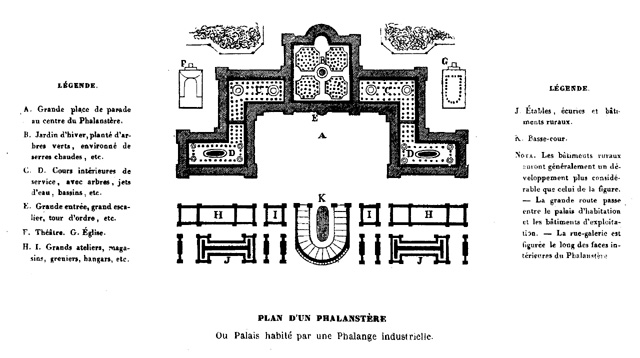
Long before the emergence of digital dating platforms, nineteenth century utopian socialist Charles Fourier imagined human attraction as something that could be systematically organized, optimized, and liberated from the failures of existing social structures. Writing in the aftermath of the French Revolution and during the rise of industrial capitalism, Fourier rejected the belief that reason, morality, or marriage formed the foundation of social order. Rather, he argued in works such as Theory of the Four Movements, Theory of Passionate Attraction and The New Amorous World that human passions were the true engines of society. Civilization, in his view, produced misery because it repressed and mismanaged desire through institutions like monogamous marriage, private property, and rigid gender roles. Against this, Fourier envisioned “Harmony,” a social order organized around the free circulation of attraction, where human relationships would be structured according to endlessly variable passions rather than reproductive obligation or economic necessity. As Joan W. Scott notes, Fourier understood desire not as irrational excess to be controlled, but as a productive social force capable of reorganizing collective life itself.1 His theory proposed that passions could be coordinated through intricate systems of association, grouping individuals according to emotional, erotic, and temperamental compatibilities in order to maximize pleasure and minimize conflict.
What makes Fourier particularly significant as an early theorist of romantic optimization is the extent to which he treated attraction as something calculable, classifiable, and socially manageable without reducing it to simple reproduction or morality. In The New Amorous World, Fourier famously developed elaborate taxonomies of personalities and passions, claiming that human temperaments could be organized into hundreds of distinct types whose desires could be harmonized through careful social arrangements.2 Joan Scott emphasizes that this was not merely fantasy, but an attempt to imagine a society where desire itself became a principle of administration. Fourier proposed systems of “confessors” who would evaluate individuals’ emotional inclinations and direct them toward compatible relationships, creating what French historian Michel Foucault later described as an “integrative utopia” where regulation operated through pleasure rather than repression.3 Yet Fourier’s project also resisted rigid categorization. His emphasis on multiplicity, shifting attractions, and non-normative sexuality challenged the nineteenth-century belief that sex existed primarily for reproductive continuity within the heterosexual family. This is why later queer theorists such as Mackenzie Wark view Fourier as radically ahead of his time. Wark argues that Fourier imagined sexuality as fluid, collective, and experimental, destabilizing fixed identities in favor of networks of relational desire. Rather than defining people through stable categories, Fourier treated attraction as dynamic and combinatory, constantly generating new forms of intimacy and social organization.4
For the early nineteenth century, these ideas were extraordinary. Fourier did not simply advocate for sexual liberation in an individual sense; he proposed a total reorganization of society around the fulfillment of desire. Women, in his vision, were not passive reproductive subjects, but equal participants in systems of pleasure and attraction, leading him to claim that the expansion of women’s freedom was the measure of social progress itself. He defended forms of sexuality condemned by bourgeois society, rejected the moral supremacy of monogamous marriage, and imagined communal structures that dissolved boundaries between labor, intimacy, and social life. At a moment when industrial modernity increasingly defined sexuality through reproduction and the nuclear family, Fourier instead imagined abundance, excess, and relational plurality.5, 6 By treating attraction as organizable, he reframes romance as a problem of structure. Fourier used utopian fantasy to expose the limitations of existing social arrangements and to imagine alternatives beyond them. In doing so, he established one of the earliest frameworks for thinking about attraction not as merely a private emotion, but as a social system that could be organized, optimized, and transformed.

Long before the emergence of computer-assisted matchmaking, personal advertisements offered one of the earliest forms of mediated romantic organization. Appearing in newspapers as early as the eighteenth and nineteenth centuries, and becoming increasingly popular in the nineteenth and twentieth centuries, Lonely Hearts advertisements allowed individuals to publicly market themselves to potential romantic partners through carefully constructed textual self-presentations. In this sense, personal advertisements established many of the same organizational principles later adopted by computational matchmaking systems: the reduction of personality into searchable traits, the categorization of romantic preferences, and the presentation of compatibility through structured information. However, unlike systems which relied upon external computational sorting, personal advertisements required users to actively participate in their own classification. Individuals translated themselves and their desires into concise descriptions, adopting a logic of optimization in which traits, preferences, lifestyles, and expectations were strategically emphasized in order to attract compatible partners. This process reflects an early form of the commodification of intimacy, where personality, appearance, morality, class status, and lifestyle become exchangeable qualities within a competitive romantic marketplace.
Empirical research of these advertisements reveals that this process was far from neutral. In Del Theisen and colleague’s study of Lonely Hearts personal advertisements, the ads consistently reflect sexually dimorphic mating strategies, which is when males and females of the same species exhibit differences in appearance or behavior beside their differing sexual organs. For example, the data notes that men are more likely to emphasize their ability to provide resources while seeking youth and attractiveness, while women are more likely to forego attractiveness and seek stability and commitment.7 Similarly, Aysan Sev’er’s analysis of over two thousand personal advertisements shows that, despite broader social changes, traditional gendered patterns remained remarkably stable. Men continuously seek younger partners, while women seek older, more established partners.8 These recurring patterns suggest that what is being “marketed” is not purely individual identity, but socially valued traits shaped by longstanding constructs and hierarchies.
In this sense, personal advertisements reveal how the organization of desire becomes intertwined with systems of value and exchange. Individuals are not simply seeking connection, but are positioning themselves competitively within a field of potential partners, emphasizing traits that increase their desirability while filtering others according to preferred criteria. Even without the presence of formal algorithms, this process mirrors later algorithmic matchmaking systems, which similarly sort and rank users based on quantifiable attributes. Personal advertisements therefore function as an important intermediary between Fourierist ideals and early computer dating experiments, demonstrating that the commodification and classification of intimacy are not solely products of digital technology, but are embedded in the ways individuals present and evaluate themselves within a romantic realm.


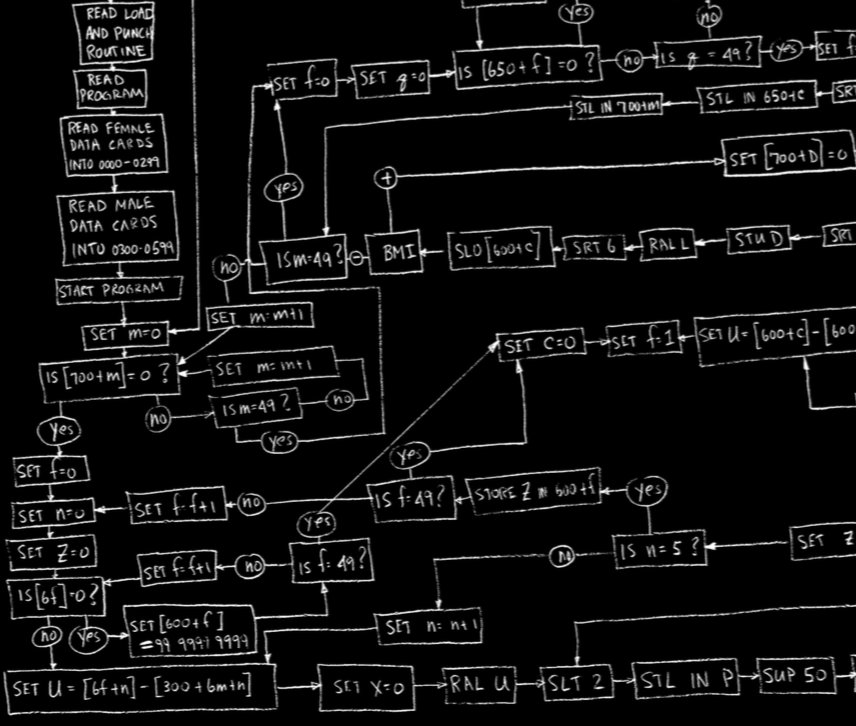
The first computer-based matchmaking system to emerge was the 1959 Happy Families Planning Service. Developed by Stanford undergraduate students Jim Harvey and Phil Fialer using an IBM 650 mainframe—one of the first widely used computers on campus following the expansion of Stanford’s computation center in the late 1950’s—the project reflected the growing cultural fascination with applying computational methods of analysis to everyday life. As C. Stewart Gillmor explains, the IBM 650 itself symbolized a new era in which computation was imagined not merely as a scientific or military tool, but as a system capable of organizing ordinary social experience, including romance and marriage.9 Their experiment began as a playful class project, attempting to pair couples together for an upcoming date party, but ultimately became the nation’s first experiment with computer-assisted matchmaking.
The compatibility system itself relied upon a deceptively simple assumption: that romantic success could be predicted through measurable similarities. Individuals were asked “Thirty questions” about their “age, height, weight, religion, personality traits, hobbies, personal habits, and number of children wished-for in a marriage”.10 The IBM 650 compared participant responses by calculating the numerical “distance” between answers, pairing together those whose preferences were most closely aligned. In this sense, the Happy Families Planning Service represented a major conceptual shift in how intimacy could be imagined. Human attraction was no longer treated as mysterious or spontaneous, but as something capable of being organized through data collection, categorization, and statistical analysis. Although rudimentary by contemporary standards, the experiment introduced a logic that would become foundational to later matchmaking systems: the idea that compatibility could be operationalized into quantifiable inputs and processed mechanically.
Despite the novelty and ambition of the experiment, its results were limited—of the 49 total pairings, none resulted in a long-term match. Foster explains that some of the pairings were unsuitable, exemplifying a single mother being paired with a college freshman.11 This gap between expectation and outcome is significant. While the computational system promised a more efficient and rational method of finding love, it ultimately revealed the difficulty in reducing complex human attraction to quantifiable data. However, the experiment does mark a crucial turning point in how we approach romantic relationships: the utopian logic of organizing desire imagined by Fourier had been translated into a technical system grounded in data and computation. Even in its failure to generate long-term couplings, the Happy Families Planning Service helped establish the enduring belief that relationships can be engineered through structured inputs, a principle which would continue to shape emerging matchmaking technologies.

Following Stanford’s Happy Families Planning Service, computer-assisted matchmaking expanded in both scale and ambition with the launch of Harvard’s Operation Match in the mid-1960s. Founded by Jeff Tarr in 1965, alongside collaborators David Crump and Douglas Ginsburg, the service emerged in response to the limited and inefficient dating environments of single-sex colleges, where mixers and informal introductions constrained the amounts of potential partners individuals could meet. As Alicia M. Chen explains, traditional dating culture at elite universities often depended on either going to mixers at other universities hoping to meet someone, or being “fixed up,” in other words, being introduced to someone who goes to a nearby college.12 Tarr, Crump, and Ginsburg wanted to make matchmaking more efficient, and Operation Match was born. Their system used structured questionnaires and an IBM 1401 computer to algorithmically sort individuals based on shared traits such as height, religion, interests, and personal preferences. The system produced a set of six matches per person by sorting users according to compatibility scores.
The system transformed romantic selection into a process of data collection and computational sorting. As Dan Slater states, Operation Match effectively “industrialized the blind date,” converting what had previously depended on social networks and coincidence into a scalable commercial enterprise.13 The service quickly expanded beyond Harvard, attracting nearly a hundred thousand participants across colleges nationwide in only a few years. Unlike Stanford’s earlier experiment, which remained localized and experimental, Operation Match commercialized algorithmic compatibility on a national scale, demonstrating that romantic optimization could function not only as a technological novelty but as a profitable business model.
At the same time, contemporary reactions to Operation Match reveal both fascination with and skepticism toward the idea of algorithmic romance. A 1965 Harvard Crimson article described students simultaneously embracing and mocking the system, capturing the cultural uncertainty surrounding computerized intimacy. One student quoted in the article remarked “I think I probably lied…I wasn’t that dumb. I wanted to get a good date.”14 The tendency for users to manipulate or exaggerate their answers further complicated the promise of scientific compatibility, revealing how human self-presentation could undermine the accuracy of supposedly objective matchmaking systems. These tensions exposed a fundamental contradiction embedded within early matchmaking technologies: although computers could expand the quantity of romantic possibilities, they could not necessarily account for physical attraction, emotional chemistry, or unpredictability.
Even the creators of Operation Match acknowledged these limitations. Jeff Tarr later explained that the system was never intended to guarantee love, but rather to increase opportunities for interaction, ultimately underscoring the distinction between efficiency and emotional connection. This limitation highlights a recurring tension that persists across the evolution of matchmaking systems: the desire to quantify attraction versus the irreducible elements of human connection. NPR’s retrospective coverage of the system notes that while the service was celebrated as revolutionary, it relied on the same enduring idea that continues to structure modern dating platforms: the belief that enough information, properly organized, could solve the inefficiencies of romance.15
Operation Match therefore occupies a critical transitional moment within the history of engineered intimacy. It extended the logic first introduced by Stanford’s Happy Families Planning Service while moving algorithmic matchmaking beyond isolated experimentation and into mass consumer culture. Fourier’s earlier utopian dream of systematically organizing desire had now become technologically operationalized through punch cards, compatibility metrics, and commercial infrastructure. They system normalized the idea that computers could intervene in intimate relationships and shape romantic outcomes through data-driven classification. Operation Match established many of the assumptions that continue to underpin modern dating applications today both the promise and limitations of early algorithmic approaches to romance.


The emergence of computer-assisted matchmaking during the mid-twentieth century cannot be separated from the broader cultural transformations surrounding gender, sexuality, and courtship occurring simultaneously in the United States and Europe. This relationship between technological organization and sexual liberation becomes especially visible with Rendezvous, a computer matchmaking system operated through the West German magazine twen between 1967 and 1970. According to Natalie R. Cincotta, the program, which emerged during the West German “sex wave,” reflected broader cultural shifts enabled by the introduction of the birth control pill, changing attitudes toward premarital sexuality, and the growing youth countercultures centered on experimentation and self-discovery. Rendezvous promised users that computers could remove the uncertainty and inefficiency of romance by scientifically identifying ideal partners according to personality, habits, and desires. But the long-term goal of this program was not to find a lifelong partner. Rather, it sought to generate brief partnerships which emphasized enjoyment over commitment. This experiment therefore most closely resembles the ideas of Fourier, as marriage was not the end goal of the matches. But, as Cincotta demonstrates, the program still produced highly normative assumptions about gender and heterosexuality, despite presenting itself as modern and sexually progressive. Rendezvous continued to sort individuals according to conventional ideas of masculinity, femininity, and romantic compatibility. The “ideal man” and “dream woman” imagined by the program remained shaped by existing social expectations rather than liberated from them.16
Although the 1960s are frequently remembered as an era of sexual liberation and expanding personal freedom, these changes unfolded unevenly and often preserved existing social hierarchies beneath the appearance of progress. As Megan M. Connerly explains in When Suzie Meets Ed: A History of Dating Advice from 1920 to 1970, the rise of second-wave feminism, womens’ increasing participation in the workforce, and the growing availability of birth control destabilized traditional courtship expectations without fully dismantling them.17 Advice manuals, women’s magazines, and popular dating culture continued to emphasize feminine attractiveness, heterosexual marriage, and gendered behavioral expectations even as women gained greater social and sexual autonomy. Connerly argues that dating culture during this period became marked by contradiction: women were encouraged to become more independent while simultaneously remaining desirable within conventional heterosexual frameworks.
This cultural instability forms the social backdrop against which early computational matchmaking systems emerged. Programs such as Operation Match, Rendezvous, and the Happy Families Planning Service did not arise in isolation from changing sexual norms; rather, they developed precisely during a moment when traditional structures of courtship were becoming increasingly uncertain. As gender roles shifted and social expectations surrounding romance loosened, computational matchmaking systems promised a new form of organization and stability. Compatibility questionnaires, statistical sorting, and algorithmic pairing offered the appearance of rationality within a rapidly transforming romantic landscape. In this sense, the rise of matchmaking technologies can be understood not simply as technological innovations, but as a cultural response to anxieties surrounding modern intimacy. These systems attempted to regulate and structure desire at the very moment when sexual norms appeared to be increasingly fluid.
This contradiction reveals a larger pattern within the history of romantic optimization. Matchmaking systems do not merely organize relationships neutrally; they reinforce the cultural values embedded within them. Even when technologies emerge during moments of apparent sexual liberation, they frequently stabilize older hierarchies under the guise of efficiency, compatibility, or scientific objectivity. Fourier’s utopian vision similarly claimed to liberate desire through organization, yet his systems still depended upon extensive classification and social management. By the mid-twentieth century, computational matchmaking inherited this same tension. While these programs promised expanded freedom and increased romantic possibility, they simultaneously narrowed desire into categories legible to social and technological systems. The result is that matchmaking technologies increasingly move beyond organizing attraction and begin subtly regulating it. Where sexual revolutions destabilize norms, systems embedded within cultural assumptions often work to reorganize and reassert them in new forms.
By the 1970s and the 1980s, matchmaking technologies had evolved beyond questionnaires and punch-card computation into increasingly visual and commercialized forms of mediated intimacy. One of the most influential of these systems was Great Expectations, a video-dating company founded in 1975 that allowed users to record self-presentations and browse a library of potential romantic partners. Unlike earlier computational experiments such as the Happy Families Planning Service or Operation Match, which framed compatibility through statistical sorting and questionnaire analysis, Great Expectations emphasized visual performance and self-marketing. Participants no longer merely answered compatibility questions; they presented themselves directly to an imagined romantic marketplace through carefully managed interviews, demonstrating their physical appearance, speech patterns, and personalities. Video dating intensified the commodification already visible in personal advertisements and computer matchmaking by transforming intimacy into something simultaneously consumable, performative, and increasingly commercial.
Great Expectations marketed itself as a solution to the growing instability of modern romance. In Pat Hinsberg’s coverage of the company’s decline in the early 1990s, the language surrounding the service reveals a striking tension between efficiency and emotional authenticity. Hinsberg notes that video dating had originally been promoted as an “ultraefficient way of separating wheat from chaff socially,” reflecting the broader cultural desire to streamline romantic selection through technology. Yet as the market weakened and competitors failed, Great Expectations increasingly attempted to reposition itself not as a fast or technologically innovative service, but as a facilitator of “the real thing—romance”. Its advertisements shifted towards stories of marriages, pregnancies, and emotional fulfillment, emphasizing successful couples rather than technological sophistication. One featured client explained that she joined the service hoping to “dodge the singles scene” and met her future husband through her very first match. The company simultaneously began offering assistance with profile writing and videotaping, further illustrating how intimacy itself had become professionally managed and curated. Romantic success was no longer imagined as spontaneous connection, but as something requiring strategic presentation, expert guidance, and technological mediation.18
This emphasis on management and optimization appears most clearly in company president Jeffrey Ullman’s exploration of the service’s purpose. According to Hinsberg, Ullman argued that “most adults are just not good selectors,” suggesting that individuals could not be trusted to navigate desire effectively on their own.19 His statement reflects a broader ideological shift visible throughout the history of matchmaking technologies: attraction increasingly becomes understood as a problem to be solved through external systems of organization and correction. Ullman even warned that men might irrationally “choose a blonde with blue eyes and a big bust” despite her being “wrong for him,” framing the company as a rational mediator capable of intervening against supposedly flawed human instincts.20 This logic closely resembles the assumptions underlying earlier computational matchmaking experiments and contemporary dating algorithms alike. The system positions itself as more objective, more efficient, and ultimately more capable of producing successful relationships than ordinary human judgement. Yet embedded within this logic is a subtle form of social control, where technologies increasingly shape not only how individuals meet, but how they are taught to evaluate desire itself.
At the same time, public responses to Great Expectations reveal growing anxieties about the mechanization and commercialization of romance. Jack Smith’s opinion piece in the Los Angeles Times repeatedly contrasts video dating with what he nostalgically describes as the “cute meet,” the spontaneous and accidental encounters romanticized in mid-century cinema. Smith mocks the idea of sitting in a “Video Library” screening potential partners through recorded interviews, questioning whether technological efficiency can ever replicate emotional chemistry. He imagines older forms of romance unfolding unpredictably in museums, buses, grocery stores, or rainstorms, arguing that these chance encounters contain forms of intimacy that systems of optimization cannot reproduce.21 In his later follow-up piece responding to a young woman who passionately disagrees with his takes on modern romance, Smith recounts a conversation with a former dating-service employee. In this conversation, the ex-employee admits that dating services allowed users to meet someone who was theoretically “perfect” on paper, yet “there’s no chemistry.”22 This distinction between measurable compatibility and emotional connection echoes tensions visible throughout earlier matchmaking systems, from Operation Match’s inability to account for attraction beyond questionnaire data, to the limitations of algorithmic matchmaking today.
Smith’s skepticism also exposes the increasingly transactional nature of mediated romance by the late twentieth century. Great Expectations charged substantial membership fees—sometimes ranging from $925 to $3100 (or about $5,500 to about $19,000 in today’s purchasing power) which positioned romantic access itself as a premium commodity. This commodification became even more visible in 1995, when The Washington Post reported that Great Expectations had settled with the Federal Trade Commission over allegations that customers were overcharged through misleading financial agreements. According to the report, some members who financed their memberships were charged interest rates “as high as 40 percent,” while others alleged they were pressured into purchasing expensive services they never really used. The FTC also accused the company of failing to properly disclose fees and financing terms. These controversies emerged despite the company continuing to advertise itself as a producer of successful marriages and meaningful relationships, claiming its services led to “two marriages every day.”23 The contradiction is telling: a system originally marketed as a rational solution to loneliness increasingly resembled a profit-driven industry depended upon maintaining consumer participation.
Great Expectations therefore represents a critical transitional moment in the genealogy of algorithmic intimacy. Earlier systems such as personal advertisements and the computational systems had already introduced the idea that attraction could be organized through structured information and compatibility metrics, but video dating transformed romantic selfhood into a visual and marketable product. Individuals were expected not only to describe themselves, but to perform persuasively for consumption within a competitive marketplace of desire. Simultaneously, the company’s emphasis on efficiency, screening, and selection anticipated many of the same promises later adopted by digital dating platforms. Yet the public skepticism surrounding Great Expectations—particularly concerns about romantic chemistry, authenticity, and commercialization—also foreshadows contemporary critiques of dating apps. Even before the emergence of Tinder or other algorithmic swiping systems, anxieties had already surfaced surrounding whether technologically mediated romance could truly produce meaningful intimacy, or whether it merely reorganized loneliness into increasingly profitable forms.


By the twenty-first century, the logic of romantic optimization that emerged through Fourier’s utopian theories, personal advertisements, and mid-twentieth century computational matchmaking experiments had morphed into algorithmic dating platforms. Applications such as Tinder no longer simply facilitate introductions between individuals; rather, they transform intimacy itself into a process of data extraction, behavioral prediction, and metric-based optimization. In “A Study of Datafication and Digital Intimacy on Tinder,” Sike Gao argues that Tinder operates through the “datafication of intimacy and love,” reducing users’ identities, desires, and interactions into measurable information that can be processed algorithmically.23 Swipes, location data, engagement patterns, profile views, messaging frequency, and user preferences become quantifiable behavioral inputs that the platform uses to regulate visibility and determine potential matches. Compatibility becomes increasingly dependent upon algorithmic interpretation rather than interpersonal unpredictability. Yet, these systems are not neutral technologies objectively pairing individuals together. Tarleton Gillespie’s “The Relevance of Algorithms” emphasizes that algorithms always reflect the priorities of the institutions that create them, shaped by economic incentives, platform design, and cultural assumptions rather than pure objectivity.24 When applied to dating apps, this reveals that algorithmic matchmaking does not simply organize desire but actively structures it according to the priorities of the platform itself. Visibility, desirability, and compatibility become regulated through systems designed to maximize user engagement and retention rather than emotional fulfillment.
Additionally, these contemporary dating systems reinforce many of the same gendered and heteronormative hierarchies visible in earlier forms of mediated matchmaking. Gao notes that Tinder’s sorting systems often privilege conventionally attractive users, reinforce heteronormative relationship structures, and replicate racialized preferences already embedded in society.25 These dynamics echo the patterns visible in earlier matchmaking systems discussed previously. Just as personal advertisements reproduced traditional gender expectations despite the social transformations of second-wave feminism, and just as Rendezvous re-stabilized normative ideas of masculinity and femininity during the West German “sex wave,” contemporary dating algorithms similarly organize desire according to culturally embedded assumptions. The continuity across these systems suggests that matchmaking technologies consistently absorb existing cultural hierarchies and repackage them as objective compatibility. What appears technological, is therefore, deeply social. The technology itself may appear modern and objective, yet the values shaping compatibility remain continuous across history. Matchmaking systems increasingly do more than organize attraction—they shape which forms of attraction become most visible, rewarded, and socially accepted.
At the same time, algorithmic matchmaking has become inseparable from consumer capitalism. The historical trajectory from the Happy Families Planning Service to Tinder reveals how quickly matchmaking systems evolved from small-scale experimental social projects into highly profitable industries. Stanford’s original experiment involved fewer than one-hundred students, and functioned primarily as a casual experiment of computational possibility. But only six years later, Operation Match had already transformed computer-based romance into a large-scale commercial enterprise with nearly one hundred thousand paying participants. Contemporary dating platforms intensify this shift even more dramatically. Tinder, Bumble, and Hinge monetize nearly every aspect of romantic interaction through subscription models, boosted profile visibility, premium matching features, and engagement-based ranking systems. Gillespie’s analysis of algorithms becomes especially important here because it exposes the tension between platform profit and user fulfillment.26 Dating apps market themselves as tools designed to help users find lasting romantic connections, yet their business models often depend upon keeping users active for as long as possible. A permanently successful match potentially removes two users from the platform entirely, creating a structural contradiction in which the economic interests of the company may conflict with the emotional interests of the individual. Compatibility is therefore shaped not only through interpersonal preference but through systems optimized for sustained engagement, continual interaction, and user retention.
This structure of endless engagement closely resembles what Michael Dango describes as “erotic serialization” in “Periodical Utopianism: Charles Fourier, Playboy, and Erotic Serialization.” Dango argues that Fourier’s utopian writing, alongside serialized erotic media such as Playboy, sustains pleasure not through fulfillment itself but through the continual deferral of satisfaction.27 Desire remains active precisely because completion is endlessly postponed. Contemporary dating apps operate according to a remarkably similar logic. The promise that the next swipe, next profile, or next match could finally be “the one” keeps users continually invested in the platform. The apps thrive upon anticipation, rather than resolution. Users are encouraged to remain open to future possibilities, continuously searching for someone potentially “better,” more compatible, or more desirable than their current match. Barry Schwartz’s The Paradox of Choice: Why More Is Less helps explain why this abundance often produces dissatisfaction rather than liberation. He argues that excessive choice, or “choice overload,” increases anxiety, regret, and self-blame because individuals become overwhelmed by the pressure to make the “best” possible decision.28 Within dating apps, this logic manifests through constant comparison and the inability to feel satisfied with present choices when infinite alternatives remain available. Romantic abundance therefore becomes psychologically destabilizing rather than liberatory.
The emotional and behavioral consequences of these systems become visible in Ashley K. Fansher and Sara Eckinger’s “Tinder Tales,” which examines patterns among dating app users and identifies increased correlations with sexual compulsivity, deception, adversarial heterosexual beliefs, and other forms of “risky” behavior. Qualitative responses within the study further reveal recurring experiences of emotional exhaustion, harassment, manipulation, ghosting, and dissatisfaction.29 These outcomes are not incidental side effects of dating apps, but reflect the broader organizational logic underpinning algorithmic intimacy. Systems structured around perpetual optimization, endless choice, and deferred fulfillment encourage users to approach relationships through patterns of consumption rather than sustained emotional investment. Individuals become simultaneously overexposed to romantic possibility and increasingly detached from meaningful connections. What emerges across these studies is a consistent historical pattern: a system that began with Fourier’s utopian desire to organize human passions toward collective fulfillment has gradually devolved into a commodified algorithmic marketplace, where intimacy is increasingly structured around engagement metrics, consumer retention, and profitable dissatisfaction rather than meaningful human connection.
Modern dating applications are often discussed as unprecedented transformations of intimacy, fundamentally reshaping how relationships are initiated, maintained, and experienced. This project argues instead that contemporary dating platforms are best understood as the culmination of a much longer historical effort to systematize romantic desire. From Fourier’s nineteenth-century fantasies of passion-based organization to twentieth-century computational matchmaking services, each system attempted to resolve the uncertainties of attraction through increasingly structured forms of classification, optimization, and social management. While the technologies themselves evolved, the underlying impulse remained remarkably consistent: to organize romantic relationships into a rational system.
By placing contemporary dating apps within this broader genealogy, this project demonstrates that modern platforms inherit not only earlier matchmaking techniques, but also the contradictions embedded within them. Systems designed to expand romantic possibilities frequently narrow individuals into categories, transforming complexity into quantifiable data. In doing so, users themselves become a commodity, encouraging individuals to present their identities as marketable profiles within competitive romantic economies. These systems also reproduce existing social hierarchies surrounding gender, desirability, race, sexuality, and class, even while presenting themselves as technologically progressive or even liberatory.
Ultimately, this project argues that dating apps do not represent a rupture from earlier histories of courtship, but rather demonstrate the long-lasting efforts to regulate and optimize human connection. The promise underlying these systems is one of fulfillment: the idea that better organization, more information, or more efficient matching can overcome the instability of romantic desire. Yet these platforms depend upon perpetual participation, continuous searching, and the endless circulation of possible matches, transforming Fourier’s utopian ideas for the future of matchmaking into a profitable product. Desire is sustained not through satisfaction, but through the promise of future optimization, ensuring that the search itself remains ongoing. And with that, the search for the perfect matchmaking system continues.